
Secular humanism: a way of living with reason, freedom, and humanity
A worldview that finds in the human capacity to think, care, and build a shared future the foundations for a meaningful life.
What makes a life good? Where do our ideas about right and wrong come from? Do we need to believe in a supernatural force to act with kindness, find a purpose, or feel wonder at the universe?
Secular humanism starts from a simple conviction: human beings can build an ethical, meaningful, and caring life based on our own capacities. Reason, experience, empathy, and knowledge enable us to understand the world, make decisions, and take responsibility for their consequences. To do this, we do not need to rely on supernatural mandates or accept truths that lie beyond the reach of critical inquiry.
This worldview is not limited to denying the existence of gods. It proposes a positive way of relating to others and to the world: recognizing the dignity of every person, protecting freedom, reducing suffering, and creating the conditions for everyone to develop their potential.
A tradition with roots in many cultures
Humanism is sometimes presented as an exclusively European Enlightenment product. Its history is considerably broader. Across different eras and societies, currents of thought have emerged that sought to explain reality through observation and reason, placing human conduct and collective well-being at the center of their concerns.
In ancient Greece, Protagoras challenged traditional explanations about the gods and emphasized the importance of human experience. In India, the Charvaka philosophical school championed a materialist worldview and rejected the authority of sacred texts. In China, the thought of Confucius and Mencius stressed benevolence, responsibility, and harmony in human relationships. In various African traditions, the Ubuntu philosophy has expressed a vision of the person deeply tied to their community: our humanity is also built in relationship with others.
These currents are not identical and should not be conflated with contemporary secular humanism. However, they show that ethical reflection, the pursuit of knowledge, and concern for life in common do not belong to a single civilization nor necessarily depend on a religion.
The modern history of humanism has brought together some of these concerns into a shared vision. A central reference is the Amsterdam Declaration, originally adopted in 1952 by the international humanist movement and revised in 2002 and 2022. The current version was approved by the members of Humanists International, the organization that represents the humanist movement on a global scale.
The declaration summarizes modern humanism in four broad commitments: striving for an ethical life, using reason, seeking personal fulfillment, and offering a source of meaning compatible with freedom of thought and human diversity. It is not a closed code or a doctrine that claims to resolve all questions in advance. It is a shared orientation for individuals and organizations that embrace these principles.
Ethics does not need a supernatural authority
One of the most common objections to secular humanism holds that, without God, there would be no basis for distinguishing good from evil. According to this view, morality would depend on divine commands, and without them, any behavior could be justified.
Humanism offers a different answer. Our capacity to care for others has roots in social life itself. Empathy, cooperation, caring for those who suffer, and a sense of fairness appear in the evolutionary history of human beings and in the behavior of other social animals. The research of primatologist Frans de Waal, for example, has helped demonstrate that certain forms of empathy and cooperation have evolutionary antecedents that predate organized religions.
This does not mean that biology alone can dictate how we should live. Knowing that a behavior has an evolutionary origin does not prove it is morally right. Ethics requires reflection: we must evaluate our actions, consider their effects, and ask what consequences they have for the lives of others.
For humanism, a moral decision deserves to be examined on the basis of criteria such as the harm it may cause, respect for autonomy, justice, and the well-being of those affected. Compassion provides sensitivity to suffering; reason helps us review our biases and consider those who fall outside our immediate circle.
Morality does not need a reward in the afterlife or the fear of supernatural punishment. We can help someone because we recognize their suffering, because we value their well-being, and because we understand that our lives are interconnected. Ethical responsibility arises from our condition as beings capable of understanding that our decisions affect others.
Reason and science as tools for understanding the world
Humanism grants a central place to reason and scientific inquiry. This does not mean thinking that science has an immediate answer to every question or that it can resolve all human dilemmas on its own. It means recognizing that, when we want to understand reality, we need methods that allow us to test claims, correct errors, and revise our conclusions.
The Amsterdam Declaration expresses a particularly important idea: science provides means and knowledge, but human values must guide the ends. Technology can expand our possibilities, yet its usefulness depends on how we choose to use it and who benefits from its advances.
This distinction matters in current debates about artificial intelligence, biotechnology, the environment, and health. It is not enough to ask what we can do. We must also ask for what purpose, with what consequences, and under what conditions. Scientific progress requires social responsibility and ethical criteria.
The humanist attitude does not consider any person or institution infallible, either. Knowledge advances through observation, discussion, and revision. Changing one's mind in light of better evidence is not a weakness: it is a sign of intellectual honesty.
The dignity and freedom of every person
Humanism starts from the value of every individual. Dignity does not depend on the religion one professes, one's origin, identity, economic standing, or usefulness to society. Every person must be able to develop their life and make decisions about it, always respecting the rights of others.
This principle has concrete consequences. It is expressed in the defense of freedom of conscience, equality before the law, personal autonomy, sexual and reproductive rights, non-discrimination, and the right to receive education based on verifiable knowledge.
It also invites us to critically examine the norms and customs that restrict people's freedom without a justification that can be publicly discussed. A tradition, however ancient, is not exempt from evaluation. Laws and institutions must be justifiable through reasons that respect the dignity and rights of all.
Humanism does not reduce freedom to an individual matter, either. We live in interdependent societies. Our decisions have effects on other people, on future generations, and on the natural environment of which we are part. Responsibility toward others is part of freedom exercised with awareness.
A meaningful life, here and now
The absence of supernatural beliefs does not compel us to live without purpose. Meaning can arise from the bonds we build, the people we love, the knowledge we seek, the work we do, creativity, and our participation in collective endeavors.
The philosopher Martin Hägglund has developed a thought-provoking reflection on this topic: precisely because our lives and our bonds are finite, what we do with them matters. The time shared with someone, the chance to help another person, or the effort to improve a situation gain value because they are not experiences we can take for granted forever.
This perspective also allows us to face death without resorting to supernatural explanations. The loss of a loved one is real and deserves to be acknowledged as such. We can keep their memory alive through the stories we share, the values they passed on to us, and the mark they left on those who knew them.
That is why humanist ceremonies hold an important place in many communities. Weddings, naming ceremonies, and funerals can be held through meaningful rituals without religious references. Their value lies in bringing people together, recognizing a transition, and expressing affection, commitment, and memory in a way that is consistent with the convictions of those who participate.
Wonder does not need a supernatural explanation, either. Learning the history of the universe, understanding the evolution of life, or contemplating the vastness of the sky can awaken a deep sense of awe. Scientific curiosity and artistic sensibility allow us to find beauty and meaning in the world we share.
An open humanism committed to others
Secular humanism does not aspire to become a new orthodoxy, nor does it demand that everyone adopt the same worldview. The Amsterdam Declaration expressly recognizes the importance of the free exchange of ideas and cooperation with people of different beliefs who share values such as dignity, freedom, justice, and human well-being.
This openness is important. In diverse societies, differences of conviction are part of life in common. The challenge is to find principles that allow us to coexist, debate, and work together without imposing a particular doctrine. A religious person can agree with a non-believer on the defense of human rights, environmental protection, or the fight against poverty. Those points of agreement make it possible to build alliances without concealing differences.
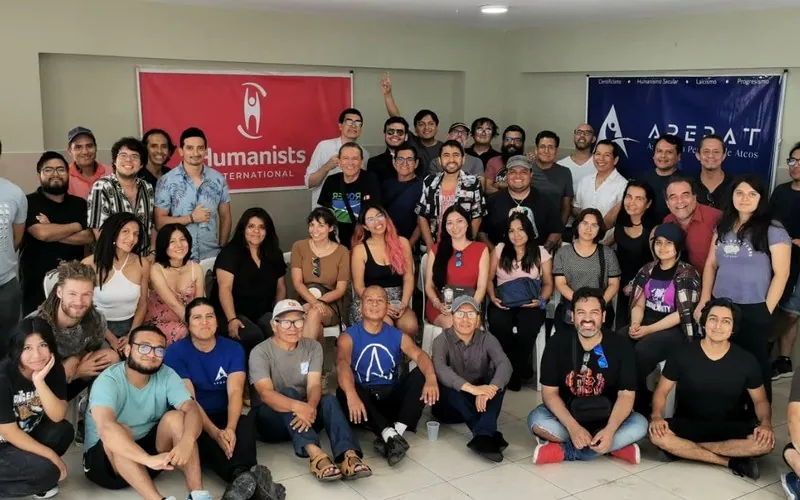
The international humanist movement works precisely in that space. Humanists International brings together organizations and individuals from numerous countries, promotes humanist values in international institutions, defends those who face persecution for their convictions, and supports the development of humanist communities in different regions. Its work shows that humanism is also a collective practice: it needs organizations, support networks, and people willing to turn their principles into action.
Humanism is also found in Lima
In August 2027, Lima will be the meeting point for this international community. The World Humanist Congress 2027, organized by Humanists International, will be held from August 20 to 22 and will bring together humanists from around the world to share ideas, experiences, and projects centered on reason, ethics, and human rights.
For those who are curious about humanism or wish to connect with people and organizations working from this perspective, it will be an exceptional opportunity to engage with a diverse and global movement. It will also offer a chance to discover how humanist values are expressed in very different cultural and social contexts.
From the Peruvian Association of Atheists (APERAT), we invite those who share these concerns—and those who want to learn more about them—to participate in this gathering. Humanism is built through reflection, but also through dialogue and collaboration among people.
Ultimately, secular humanism calls on us to take responsibility for the life we have and the world we share. It invites us to think freely, act with empathy, learn from our mistakes, and ensure that the opportunity to live with dignity is within everyone's reach. It does not offer definitive answers about the universe, nor does it promise a life free of hardship. It offers something closer and more demanding: the possibility of building, together, a meaningful life.
Learn more about humanism and join the World Humanist Congress 2027 in Lima, August 20–22.